Showing posts with label sex. Show all posts

11 November 2010

Real Sexy Scientists Prefer Socks: A Belated Halloween Post

I did another Google image search, this time for "scientist" themed Halloween costumes.  Unsurprisingly, the majority of masqueraders were "mad," and male. The first page of results revealed only three females dressed as scientists:


Surprised by the amount of leg they're showing around toxic chemicals?  I doubt it.  Needless to say, the male majority of the results were not as sexy:


Although some were pretty adorable:


There are a variety of costumes that represent real professions: firefighters, cops, soldiers...  Granted, women have managed to make all of these costumes "sexy."  God forbid a woman dress up for Halloween and not be wearing thigh high boots:

Can you really fight fires in that?  Whatever.  I get it.  It's a day where you're allowed to dress provocatively without being unfairly labeled. In college, I was a "sexy train" one year.

I defy you to find a sexier train.  But let's talk about the non-sexy costumes. Why aren't any of them accompanied by a stereotypical psychological state, like "mad?"  Nobody dresses up as a "sad cop," or an "impatient soldier."  In fact, most of the fake men-in-uniform seem to be perfectly normal human beings:


Just once, I would like to see someone dressed as a perfectly rational scientist, his or her hand on the shoulder of another perfectly rational scientist, as they work together in the collaborative human effort we call "science."  Also just once, I would like to see a fake scientist who can be sexy without having to wear garters into the imaginary lab, because real sexy scientists tend to prefer socks.

Just for reminiscing's sake, and to prove that I didn't always just sit around and complain about stereotypes all day, here is the full group of "sexy women in uniform" from 2006:

30 July 2010

Google reveals our stereotypes, plus, sexy scientists in their skivvies!

Science textbooks have been trying hard to include photographs of multi-gendered, multi-cultural scientists. But has our image of the "scientist" really been affected by these attempts at equity? Today I Google-imaged "scientist" just to see what I would get.
There are a couple of things I noticed immediately about these results.
  1. Our collective image of the "scientist" wears a lab coat.  Only one of the 33 pictures on the first page of results is not wearing one.
  2. The color scheme of our collective "scientist" is apparently blue, green and white.
  3. Of 33 pictures on the first page of results, 7 of them include women. 2 of those pictures with women come from a the same web comic, and are actually jokes, leaving five serious depictions of women in science.
  4. In the 33 pictures of scientists in the first page of results, there are 21 pairs of glasses.
  5. In 22 of the pictures on the first page of results a scientist is working with or displaying some kind of mysterious liquid in a test tube or beaker.  In fourteen of these 22, the liquid is bubbling or smoking ominously.
  6. 3 of the 33 pictures on the first page of results depict a scientist who looks like they might possibly not be white.  It's hard to tell.  Two of those three questionably ethnic scientists are also women.
  7. At least nine of the scientists appear to be "mad."
  8. In the first two pages of results, there are only four real photographs of women "doing science."  One of those four is a model in a lab coat and little else, shown below.
Did anybody else notice something interesting about our emergent image of the scientist?  Please, comment!

17 February 2010

Middlesex, Intersex Cats and Sweat Glands

I finished Middlesex this week, a novel by Jeffrey Eugenides about an intersex child with XY chromosomes and female-like genitalia who is raised as a female only to become a man as she goes through puberty. It was an interesting read, especially because of the iceberg-sized issues of gender identity and physical genetics of which the narrator reveals 'just the tip.' The book got me thinking about chromosomes, which, as a student of astrophysics I know very little about. What I do know is this: I have two Xs, and that's why I'm a "girl." It's also why I sweat more on some parts of my body than others, something that several of my female friends have admitted to as well. Without over-sharing (a habit of mine), allow me to explain.

The presence of sweat glands on the skin is an X-linked gene, meaning that it only exists on X chromosomes. The vast majority of men have only one X, so if they have the gene for sweat glands, they will have sweat glands all over, and if they don't have it, they won't. However, those of us with two X chromosomes (commonly known as females) could have one X with the sweat gene, and one X without it. Apparently if this is the case, during the development of the embryo, when the woman-to-be is just a handful of cells, each cell will randomly follow the genetic instructions of one X chromosome and dump the other one. These cells then multiply (a process called mitosis) resulting in patches of cells that have one gene, and patches of cells that have the other one.

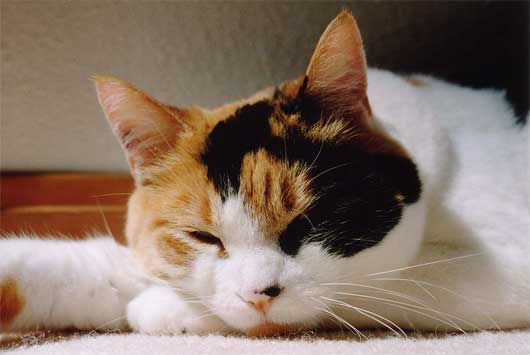
Calico cats are the same way. Orange coloration and black coloration are carried on the X chromosome. Male (XY) cats only have one X, and therefore they carry the gene for only one of these colors. But female (XX) cats have two X chromosomes, and could have the genes for both colors. If they do, their cells will go one way or the other during embryonic development, multiply that color during mitosis, and produce a beautiful tricolor kitten. In a way, women like me are the calico cats of the human world. Only instead of having beautifully patterned fur, we have patchy sweat glands...but let's not overthink it. Just let me have my metaphor.

Interestingly enough, the calico cat is the official "Maryland State Cat." You learn something every day.

There are calico cats that are not female, but these are very rare. My grandmother's friend Laura Gould wrote a book spotlighting her own male calico, George, called Cats are Not Peas. These cats are usually XXY, a combination that is known as Klinefelter's syndrome in humans. Some people with Klinefelter's (not all, just some) identify themselves as intersex, like Callie, the fictional narrator of Middlesex. Callie is not XXY, but rather has a mutation on another chromosome that altered her development in the womb.

The name Callie is short for Calliope, one of the muses of Greek mythology. But for me the name conjures images of calico cats, especially those rare males, the gender benders of the feline world, displaying their genetics in tricolor glory for all to see.

(Keep in mind that my explanation is deceptively simple. Thanks to Marnie for explaining this all to me a few years ago. For more about the complexities of calico cat genetics, I think this site lays it all out pretty clearly.)