02 August 2010

Nerdy Chic: Designing with Science

Confession: Despite my claims at rationality, I spend at least half of my time online perusing design and organization blogs.  My favorites include Apartment Therapy, Chez Larsson, Design Sponge, Manhattan Nest and Ikea Hacker, among others.  I love seeing how other people have organized their homes and lives in creative ways, and I dream that someday I will have the time and space for such endeavors.

In my attempts to create a somewhat unique space on a graduate student budget, my apartment has taken on something of an accidental nerdy-chic style.  I mean, I'm pretty nerdy (but also chic, right guys? right?) so it makes sense.  I have a framed piece of wrapping paper printed with pages from a human anatomy textbook, several botanical watercolors by my grandmother, a small collection of pine-cones, and a vintage celestial globe given to me in high school.  I also have glass bottles in many shapes and sizes scattered around the apartment, in which I cultivate philodendron cuttings and germinated seeds from my leftover produce, and handmade throw pillows (I had a lot of time last summer) with appliquéd sea creatures on them (an octopus and a sting ray).   Adding to the sense of nerd-dom are bookshelves full of astronomy texts, tattered fiction and education journals, and of course me, the resident nerd.

It turns out I'm not alone.  Science style is all over the place, and has even been spotlighted several times on Apartment Therapy.  Check out some of these science-inspired pieces on my secret lust-list.

Textbook inspired pillows by Heather Lins Home.  The best part is the addition of the figure numbers.

Has anybody else noticed that taxidermy and botanicals are beyond hip right now?

Hey these guys totally stole my idea.  I love how BIG they went with it though!
This globe looks a lot like mine.  I think the lines of it are very mid-century; I could see it on Don Draper's desk.

Too cool.  Hey doctor friends, could you get your hands on an x-ray for me?

A lovely turn-of-the-century (the one before last) photograph of Lick Observatory, one of my favorite places.  Would look awesome on my wall.
I think I need some of these flasks to complement my bottles.  They make perfect flower vases!  Plus, you can conveniently measure out the cut plant food.

 And of course the dream of the mid-century wooden ant-farm complete with queen.

30 July 2010

Google reveals our stereotypes, plus, sexy scientists in their skivvies!

Science textbooks have been trying hard to include photographs of multi-gendered, multi-cultural scientists. But has our image of the "scientist" really been affected by these attempts at equity? Today I Google-imaged "scientist" just to see what I would get.
There are a couple of things I noticed immediately about these results.
  1. Our collective image of the "scientist" wears a lab coat.  Only one of the 33 pictures on the first page of results is not wearing one.
  2. The color scheme of our collective "scientist" is apparently blue, green and white.
  3. Of 33 pictures on the first page of results, 7 of them include women. 2 of those pictures with women come from a the same web comic, and are actually jokes, leaving five serious depictions of women in science.
  4. In the 33 pictures of scientists in the first page of results, there are 21 pairs of glasses.
  5. In 22 of the pictures on the first page of results a scientist is working with or displaying some kind of mysterious liquid in a test tube or beaker.  In fourteen of these 22, the liquid is bubbling or smoking ominously.
  6. 3 of the 33 pictures on the first page of results depict a scientist who looks like they might possibly not be white.  It's hard to tell.  Two of those three questionably ethnic scientists are also women.
  7. At least nine of the scientists appear to be "mad."
  8. In the first two pages of results, there are only four real photographs of women "doing science."  One of those four is a model in a lab coat and little else, shown below.
Did anybody else notice something interesting about our emergent image of the scientist?  Please, comment!

22 July 2010

How to Control Things With Your Mind FOR REAL

I'm not sure how this escaped my notice, but technology that uses BRAINWAVES to control machines is now SO ACCESSIBLE that they've built it into kids' toys. That's right, they're making toys where you can put on a headset and control the movement of objects with YOUR MIND. Is anybody else peeing their pants right now?

13 July 2010

In the Spirit of the MLB All-Star Break: Curve-ball Physics

I thought I would take a break from the kind of science that you have to think really hard about, and reflect on the simple physics behind the curve-ball.  We're talking about a pitch that is SO counterintuitive that for years, baseball experts couldn't even agree on its existence.  Well it turns out the pitch exists in a major way.  A good curve-ball can arc a solid foot and a half away from its original path, and be close to impossible to hit.  Vin Scully called Clayton Kershaw's curve, which he's about to lob in the photo below, "public enemy number one"; this pitch is no joke.


In 1852, a German-Jewish physicists named Heinrich Magnus (below) was the first to describe the way objects spinning in a fluid create a kind of whirlpool around themselves, which has the effect of pushing them slightly off course.  This phenomenon, known as the "Magnus Effect," is what makes curve balls curve.

08 July 2010

Emergence, Patternicity and "The Wave": Are we all crazy?

After reading Emergence by Steven Johnson, I was left wondering why we have so much trouble abandoning the watchmaker metaphor--which Johnson refers to as "the myth of the ant queen"--and accepting the idea that nature can regulate itself.  Patterns occur in nature because individuals make decisions based on what's right next to them, and these decisions average out into big trends.  Take ants (of course) for example: one forager ant meets five other ants that smell like foragers, and she decides to switch to nest maintenance.  This tiny decision, when scaled up, creates an enduring ratio of foragers to nest maintenance workers in the colony that can last for decades.  Yet we still can't drop the image of the dictatorial queen!

My own graduate work is on how people conceptualize things that are really, really big.  So of course my first guess for what obstacle might be keeping our brains from accepting emergence was the scale necessary for the phenomenon to be possible. For example, let's say that one forager ant met five forager ants by accident, and she switched to nest maintenance unnecessarily. On a local level, that ant is going against the pattern. But when decisions about what job to do are made by hundreds or even thousands of ants, a stable ratio emerges. In the same way, there are always a dozen or so drunk baseball fans who throw up their arms too early or too late as "The Wave" moves around Dodger Stadium.   But on a scale of thousands of Dodgers fans deciding individually when to throw their hands up, a stable wave pattern emerges that moves fluidly through the stands.  We struggle to extrapolate this phenomenon to nature because, outside of sporting events, we don't usually hang around with tens of thousands of other humans.


29 June 2010

Emergence: It's not just about ants, but sperm, and cities, and flowers, and computer programming and...

I don't often ponder theology, especially not publicly.  But my obsession with social insects has led me to start reading about a phenomenon that I find, well, somewhat divine.  And yet at the same time this phenomenon is utterly mundane--the epitome of designerlessness.  It's called "emergence."

Emergence is the invisible hand described by Adam Smith, at work not only in free markets, but in the organization of almost everything in the natural world.  (I highly recommend  the book Emergence by Steven Johnson.  He lays out several fascinating examples of emergence in nature, and talks about how the phenomenon will apply to our technology in the future.  The book was written before social networking and Wikipedia, so it could use a second edition, but it is fascinating nonetheless.)

Emergence guides the development of a fetus, dictates when the cherry blossoms appear, and creates thoughts from electrical impulses.  And, of course, emergence is at the heart of why ants are so darn cool.  Enduring systems of positive and negative feedback on a very local scale will inevitably create structure on very large scales, and that's it.  The system itself is the designer, with each component doing his (or more likely her) part.  The power of creation is not outside of nature, but within it.

01 June 2010

How I poisoned four people (and other musings on the epistemology of science)


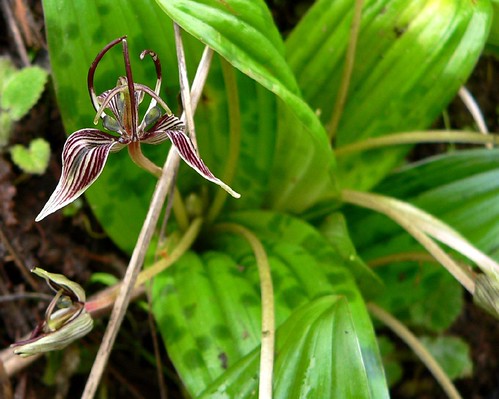
I borrowed my grandmother's wildflower book for the Skyline to the Sea hike yesterday, and we managed to identify some pretty cool plants.  We found Red Clintonia, Globe Lilies (see photo on right), Giant Wake Robin, and Hairy Star Tulips, among dozens of others.   I think I may have been more excited about the names than the flowers.  My favorite name was Rattlesnake Plantain, which the book explained was "named for it's discoverer, John Goodyear."  What?  Was his real name John Rattlesnake Plantain Goodyear?  And what do desert reptiles and jungle fruits have to do with the redwood forest?  I have yet to figure this one out.

It was fun to put names to flowers, but the futility of it was always in the back of my mind.  Humans love to assign vocabulary words to things, to taxonimize, categorize, classify. But does a Fetid Adder's Tongue by any other name not smell as fetid? 

21 May 2010

BEAVERS ARE AWESOME

Forget about ants, I have a new animal obsession: the beaver.  A few hours ago my Netflix account recommended--based on my interest in Blue Planet and Raising Arizona--that I watch the recently released DVD version of the 1988 IMAX starring the busy semi-aquatic builders. And because I dutifully do everything my Netflix tells me to, I watched it.

Beavers (The Biggest Dam Movie You Ever Saw) was cute; I'll give it that.  But beyond that, the movie is short, and the picture it paints of beaver life is painfully shallow.  It raised a lot more questions than it answered.  I know beavers make dams, but how?  How do they choose the spot?  How do they carry those huge trees?  How do they know where to put the wood?  Do the males and females take on different building roles?  How do they decide where to put their home?  What are the advantages for the beavers of the drastic changes they make in the ecosystem around them?  How do they rebuild when a bear attacks the dam??????????

I was also puzzled by the tameness of the interactions between the beavers, the cameras and the other animals in the film.  Why didn't the bear eat the beaver?  Why didn't the skunk scent the beaver?  How could there possibly be a situation where a beaver fells an aspen with a bear cub still in it????????

05 May 2010

Argentine Pirate Ants

Last night Stephen Colbert interviewed a myrmecologist with a new book out.  If you've glanced even casually at previous Zblog entries you've probably noticed the recent development of a borderline unhealthy fascination (obsession?) with ants--so this was right up my alley.  The myrmecologist was Mark Moffett, (whose surname brings back warm memories of living on Moffett Field when I worked for SETI in 2006), and the book he wrote looked amazing, so if you haven't gotten me a birthday present yet...

Moffett announced that California was being invaded by Argentine Ants (Linepithema humile) who are terrific at stowing away on boats.  Colbert took this to indicate that these were "Pirate Ants."  But if my sources are correct (and Johnny Depp is rarely wrong), pirates are rarely stowaways, preferring instead to make their presence felt quite dramatically. These ants are more like armies of conquistadores than simple pirates.  They come, they detect chemical signals, they conquer.


30 March 2010

Maui: ISEE, Inquiry and Exoplanets

I spent the last week in Maui (poor me) at a workshop for science and engineering educators.  Most of the participants were STEM graduate students or post-docs from UCSC or University of Hawaii, but with a little bit of astrophysics research experience under my belt I fit right in, despite my newly minted social scientist identity.  

The workshop focused on "inquiry," a word abused by curriculum developers, politicians and school organizations alike.  Inquiry is often confused with descriptives like "hands-on," or "using the scientific method," or described as some kind of unstructured free play.  Barry Kluger-Bell, drawing on his experience with the Institute for Inquiry at the Exploratorium in San Fransisco, led us in an inquiry about light and shadow that was illuminating even to participants with PhDs in physics.  My group presented our discoveries to the group on the poster to the left.

The Exploratorium's Institute for Inquiry, where my advisor Doris Ash spent many years, has developed the following description of a "true" inquiry activity: 

"an approach to learning that involves a process of exploring the natural or material world, and that leads to asking questions, making discoveries, and testing those discoveries in the search for new understanding."

15 March 2010

A visit to TLC: a real ranch, with real pigs, and real pig sex

Today Carolina and I took a trip out to Aromas to visit TLC Ranch (Tastes Like Chicken), where I get eggs at the farmers market every Wednesday.  It was an unbelievably perfect day (a common California phenomenon) and the ranch was overrun by hundreds of new piglets.  And here's the best part: the piglets were running, playing and suckling, like real piglets.

A running piglet looks a lot like a puppy, with wildly flopping ears and a clumsy stop, sometimes tumbling into piles of other piglets.  Unlike most pigs in the country, who are raised exclusively inside and whose tails are cropped so that other pigs don't chew them off after they go insane (true story), these pigs looked like, well, pigs.  It warmed my heart.  And the chickens?  They looked like chickens!

17 February 2010

Middlesex, Intersex Cats and Sweat Glands

I finished Middlesex this week, a novel by Jeffrey Eugenides about an intersex child with XY chromosomes and female-like genitalia who is raised as a female only to become a man as she goes through puberty. It was an interesting read, especially because of the iceberg-sized issues of gender identity and physical genetics of which the narrator reveals 'just the tip.' The book got me thinking about chromosomes, which, as a student of astrophysics I know very little about. What I do know is this: I have two Xs, and that's why I'm a "girl." It's also why I sweat more on some parts of my body than others, something that several of my female friends have admitted to as well. Without over-sharing (a habit of mine), allow me to explain.

The presence of sweat glands on the skin is an X-linked gene, meaning that it only exists on X chromosomes. The vast majority of men have only one X, so if they have the gene for sweat glands, they will have sweat glands all over, and if they don't have it, they won't. However, those of us with two X chromosomes (commonly known as females) could have one X with the sweat gene, and one X without it. Apparently if this is the case, during the development of the embryo, when the woman-to-be is just a handful of cells, each cell will randomly follow the genetic instructions of one X chromosome and dump the other one. These cells then multiply (a process called mitosis) resulting in patches of cells that have one gene, and patches of cells that have the other one.

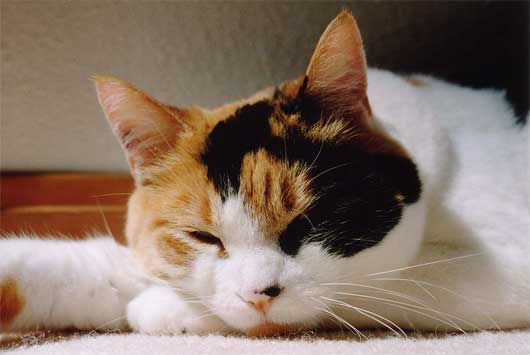
Calico cats are the same way. Orange coloration and black coloration are carried on the X chromosome. Male (XY) cats only have one X, and therefore they carry the gene for only one of these colors. But female (XX) cats have two X chromosomes, and could have the genes for both colors. If they do, their cells will go one way or the other during embryonic development, multiply that color during mitosis, and produce a beautiful tricolor kitten. In a way, women like me are the calico cats of the human world. Only instead of having beautifully patterned fur, we have patchy sweat glands...but let's not overthink it. Just let me have my metaphor.

Interestingly enough, the calico cat is the official "Maryland State Cat." You learn something every day.

There are calico cats that are not female, but these are very rare. My grandmother's friend Laura Gould wrote a book spotlighting her own male calico, George, called Cats are Not Peas. These cats are usually XXY, a combination that is known as Klinefelter's syndrome in humans. Some people with Klinefelter's (not all, just some) identify themselves as intersex, like Callie, the fictional narrator of Middlesex. Callie is not XXY, but rather has a mutation on another chromosome that altered her development in the womb.

The name Callie is short for Calliope, one of the muses of Greek mythology. But for me the name conjures images of calico cats, especially those rare males, the gender benders of the feline world, displaying their genetics in tricolor glory for all to see.

(Keep in mind that my explanation is deceptively simple. Thanks to Marnie for explaining this all to me a few years ago. For more about the complexities of calico cat genetics, I think this site lays it all out pretty clearly.)

04 February 2010

MacGyvering

In the depth of my myrm-mania a few weeks ago, Chris recommended an episode of MacGyver where Mac goes into the jungles of the Amazon to battle an army of flesh-eating ants. I had never seen an episode of MacGyver, but Chris has trouble remembering what he had for breakfast this morning so I figured if he was recounting details of a TV show that hasn't been on the air for twenty years it must be something special. CBS has every episode of MacGyver available to watch streaming on their website so I checked it out. The episode is called Trumbo's World, and when I watched it last week I had no idea what I had been missing. It's like Rockford Files (of which I've seen every episode) meets Bill Nye the Science Guy. The streaming quality was poor so I Netflixed it immediately.